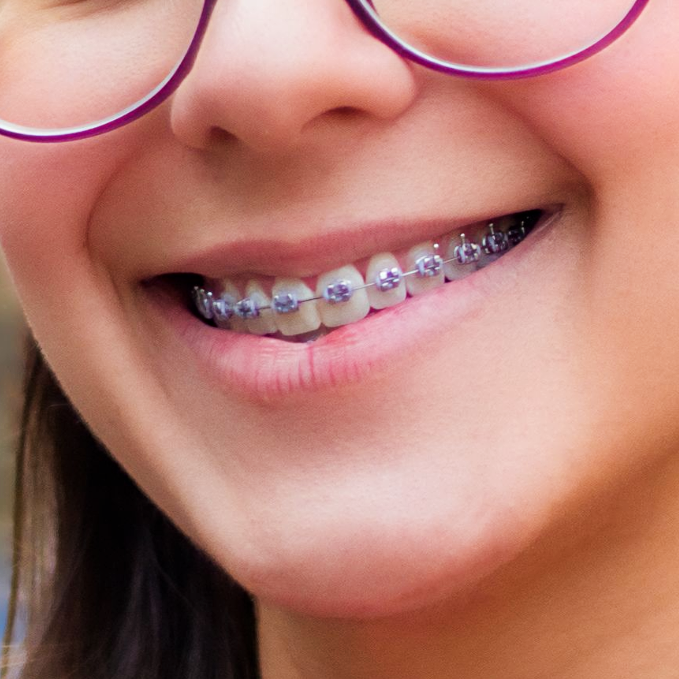
When should my child see an orthodontist? 10 signs to look out for…

Does your child already need to see an orthodontist, or is it safe to wait a little longer? Many parents ask themselves this question, and rightly so. Not every crooked tooth means that braces are needed straight away, but some problems are best monitored from an early age.
Of course, as a parent, you do not need to be able to make an orthodontic diagnosis. However, there are several things you can look out for yourself. During a routine check-up, your dentist may also recommend having an orthodontist assess your child’s teeth and jaws.
An initial orthodontic assessment often takes place around the age of 8. By this stage, the first permanent teeth have usually erupted, making it possible to assess the development of the teeth and jaws properly.
# Which 10 signs mean you should ask your dentist for advice?
1. The clearest sign comes from your dentist!
During a check-up, your dentist tells you that your child’s bite or dental development is not progressing quite as expected.
Sometimes, as a parent, you may not notice anything unusual at all.
During a check-up, your dentist looks at more than just cavities. They also assess how your child’s teeth are developing. For example, they may notice that certain teeth are not erupting when expected, that there is not enough room for the teeth, or that the way the upper and lower teeth fit together needs further attention.
Take this advice seriously, even if your child has no symptoms or complaints. An orthodontic assessment does not automatically mean that treatment will be necessary. It may simply mean that your child’s dental development needs to be monitored more closely.
2. Your child’s teeth do not fit together properly
Do you notice that the upper and lower teeth do not line up properly when your child closes their mouth? Or does the lower jaw seem to shift to one side when they bite down?
This could be a crossbite. With a crossbite, some teeth are positioned differently in relation to their opposing teeth than you would normally expect.
A crossbite is one of the conditions for which an early orthodontic assessment can be important. In some cases, treatment between approximately 7 and 9 years of age can help guide jaw development.
Have you noticed anything unusual about the way your child bites? Discuss it with your dentist.
3. The upper front teeth sit behind the lower front teeth
In some children, the lower front teeth sit in front of the upper front teeth when the mouth is closed. This may also be a sign that the bite is not developing optimally.
In cases like this, known as an 'anterior crossbite', an orthodontic assessment at an early age can be important. While children are still growing, there may be opportunities to guide jaw development.
4. There is a gap between the upper and lower teeth when your child closes their mouth
When the upper and lower teeth do not meet as the mouth closes, this is known as an open bite.
There can be several reasons for this. A persistent habit such as thumb-sucking may play a role, as can certain tongue habits or mouth breathing.
The most important thing is to have the cause assessed by your dentist or an orthodontist. You do not need to work out the cause of the open bite yourself.
5. Your child still sucks their thumb frequently or has other persistent habits
Thumb-sucking is perfectly normal in young children. However, if the habit continues for a long time, it can affect the development of their teeth.
Other habits may also be relevant, including an unusual tongue position or persistent mouth breathing.
If you are concerned, discuss it with your dentist. When a habit may affect dental development, an orthodontist can assess the situation even at a young age.
6. A baby tooth remains in place while the permanent tooth is already coming through
Sometimes, a permanent tooth appears to be erupting in an unusual position, or a baby tooth remains in place when you would expect it to fall out.
Your dentist is often the first to notice this during a routine check-up. An unusual eruption pattern in permanent teeth is a good reason to have your child’s dental development assessed more closely.
In certain cases, an early orthodontic assessment may help prevent problems with tooth eruption.
7. There does not seem to be enough room for the new teeth
Are your child’s permanent teeth coming through very close together? Or does it look as though a new tooth is struggling to find its place?
Lack of space is another issue your dentist may identify. Sometimes, there is not enough room because a baby tooth has been lost prematurely.
An orthodontist can assess how your child’s teeth are likely to develop and whether it would be beneficial to take action at an early age.
Important: some crowding while baby teeth are being replaced by permanent teeth does not automatically mean your child needs braces. The development of the teeth must be assessed as a whole.
8. The upper front teeth stick out noticeably
Are your child’s upper front teeth positioned significantly further forward than their lower teeth? Your dentist may recommend consulting an orthodontist.
When there is a pronounced difference between the upper and lower jaws, it may be beneficial to plan treatment around the growth spurt. Timely treatment may also help reduce the risk of injury to the front teeth.
9. Your child’s upper teeth overlap the lower teeth too deeply
With a deep bite, the upper front teeth cover the lower front teeth excessively when your child bites down.
A deep bite does not always need to be treated at a young age. Often, the development is monitored first, and treatment is planned for the most appropriate time. However, if there is tooth wear or irritation of the gums or oral mucosa, an earlier assessment may be advisable.
10. Your child feels self-conscious about their teeth
Not every orthodontic concern is functional. Sometimes, it is primarily the appearance of their teeth that makes a child or teenager want to change something.
In this situation, orthodontic treatment may help improve their self-confidence. The best time to start treatment depends on the development of the teeth and, in this case, also on your child’s motivation, as the concern is mainly aesthetic.
# When should you have your child’s teeth assessed?
There is no single perfect age at which every child should see an orthodontist. Some problems are best assessed early, while others can be monitored throughout childhood and adolescence as the child grows.
An orthodontic assessment around the age of 8 is often a good opportunity to check how the teeth and jaws are developing.
If your child has a noticeable crossbite, an open bite or certain persistent habits, an assessment before the age of 9 may be important. Other concerns, such as a mild bite irregularity or an aesthetic issue, can often be addressed later.
# Important: do not try to diagnose the problem yourself!
A tooth that looks unusual, a small gap between the teeth or a bite that looks different from those of other children the same age does not automatically mean there is an orthodontic problem.
Every child’s teeth develop differently. In addition, during the transition from baby teeth to permanent teeth, some teeth may temporarily look crooked or appear to be in an unusual position.
Use the signs above as a reason to ask your dentist questions, rather than as a basis for making your own diagnosis.
Not sure? Ask your dentist for advice!
___________________________________
The most important advice for parents is simple: do not assume that a problem will necessarily disappear on its own, but do not worry about every crooked tooth either.
Have you noticed anything unusual about your child’s teeth or the way they bite? Or has your dentist indicated that your child’s dental development needs extra attention?
Ask whether an orthodontic assessment would be helpful.
A first visit to the orthodontist does not automatically mean that your child will need braces. Sometimes, the best advice is simply to wait a little longer and monitor their growth.
The main purpose of an early assessment is to help you make the right decision at the right time.